
Self host
A self-hosted speed test runs the Ookla Speedtest CLI from your own network, on
a schedule, and keeps every result. baudflow ships as a multi-arch, non-root
image: the CLI is already inside, with no elevated capabilities. Below: docker run,
Compose, and Kubernetes.
You need
- Postgres: any reachable 14+ instance. baudflow owns its schema and migrates it on boot.
- A secret:
SECRET_KEY_BASE, 64+ bytes. Generate withopenssl rand -base64 48. - A host + port: the container listens on
4000; put your reverse proxy in front.
That’s it: no config file, no volume mount, no CAP_NET_RAW. Everything else is
an env var. Pick a method.
Docker
The fastest path. Bring your own Postgres and point the container at it:
# generate a signing key (>=64 bytes) once, reuse it across restarts
SECRET_KEY_BASE=$(openssl rand -base64 48)

docker run -d --name baudflow -p 4000:4000 \
  -e DATABASE_URL="ecto://postgres:postgres@host.docker.internal/baudflow" \
  -e SECRET_KEY_BASE="$SECRET_KEY_BASE" \
  -e PHX_HOST="baudflow.example.com" \
  ghcr.io/v1nvn/baudflow:0.11.8

# open http://localhost:4000
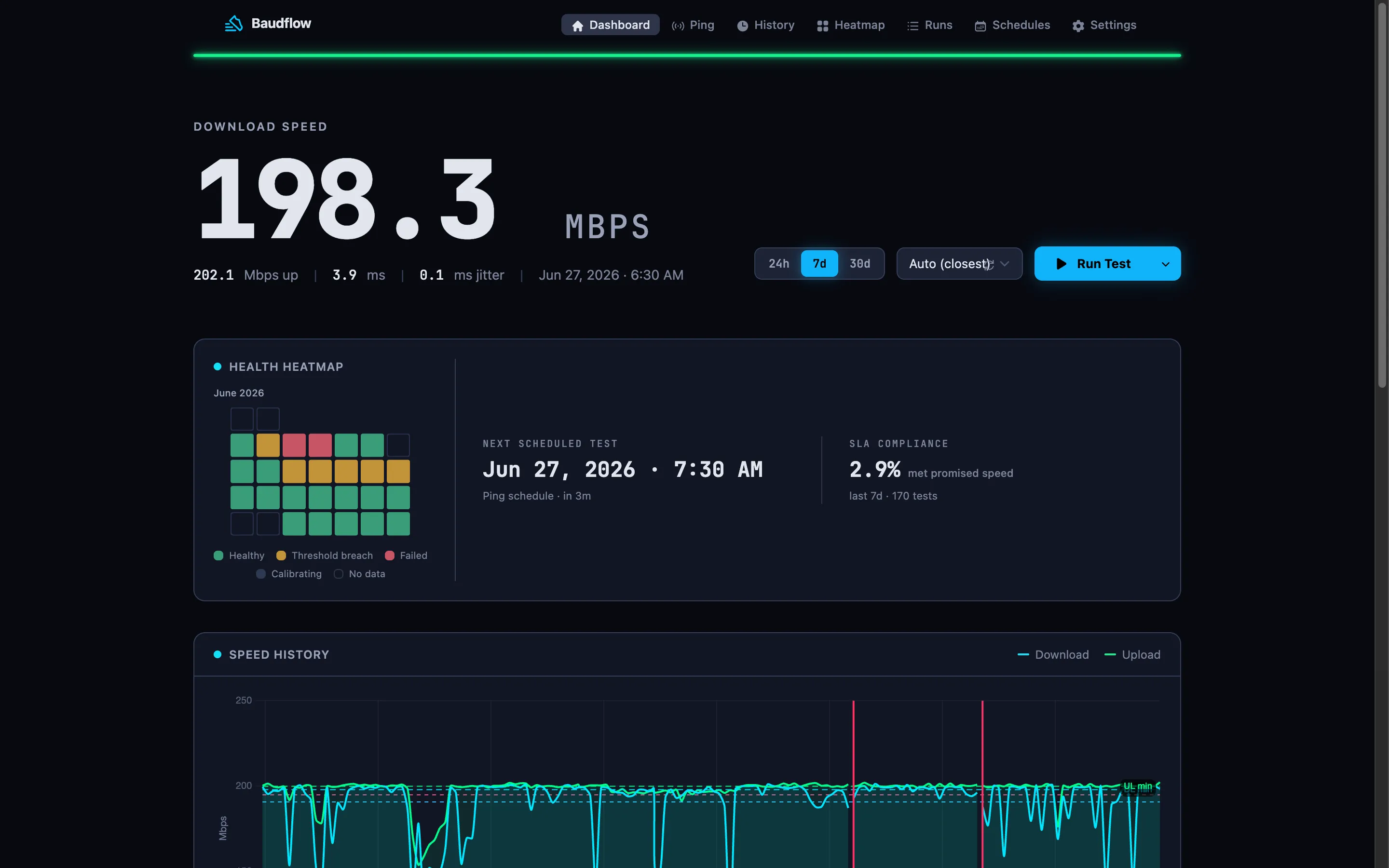
The release runs migrations on boot, so the first start also lays down the schema. Point a browser at port 4000; this is what you should see:
Docker Compose
baudflow and Postgres in one file, with a healthcheck gating startup:
# docker-compose.yml  -  baudflow + postgres in one command
services:
  db:
    image: postgres:18
    environment:
      POSTGRES_USER: baudflow
      POSTGRES_PASSWORD: change-me
      POSTGRES_DB: baudflow
    volumes:
      - pgdata:/var/lib/postgresql/data
    healthcheck:
      test: ["CMD-SHELL", "pg_isready -U baudflow"]
      interval: 5s
      retries: 5

  app:
    image: ghcr.io/v1nvn/baudflow:0.11.8
    restart: unless-stopped
    ports:
      - "4000:4000"
    environment:
      DATABASE_URL: "ecto://baudflow:change-me@db/baudflow"
      SECRET_KEY_BASE: "${SECRET_KEY_BASE}"   # set in a .env file
      PHX_HOST: "baudflow.example.com"
      PHX_SERVER: "true"
    depends_on:
      db: { condition: service_healthy }

volumes:
  pgdata:
Put the secret in a sibling .env so it never touches the compose file:
# .env  (gitignored)
SECRET_KEY_BASE=replace-with-openssl-rand-base64-48
$ docker compose up -dKubernetes
A single manifest: Namespace, Deployment (auto-migrates), Service, Ingress. Uses
a portable networking.k8s.io/v1 Ingress so it works under Traefik, nginx-ingress,
or Caddy unchanged.
apiVersion: v1
kind: Namespace
metadata:
  name: baudflow
---
apiVersion: apps/v1
kind: Deployment
metadata:
  name: baudflow
  namespace: baudflow
spec:
  replicas: 1
  strategy:
    type: Recreate          # single replica; avoid two app pods fighting over schedules
  selector:
    matchLabels:
      app: baudflow
  template:
    metadata:
      labels:
        app: baudflow
    spec:
      securityContext:       # the image needs no special capabilities
        runAsNonRoot: true
        runAsUser: 1000
        runAsGroup: 1000
        fsGroup: 1000
      containers:
        - name: baudflow
          image: ghcr.io/v1nvn/baudflow:0.11.8
          ports:
            - containerPort: 4000
              name: web
          env:
            - name: DATABASE_URL
              valueFrom:
                secretKeyRef: { name: baudflow-db, key: uri }
            - name: SECRET_KEY_BASE
              valueFrom:
                secretKeyRef: { name: baudflow-secrets, key: secret-key-base }
            - name: PHX_HOST
              value: baudflow.example.com
            - name: PHX_SERVER
              value: "true"
          livenessProbe:
            httpGet: { path: /health, port: web }
            initialDelaySeconds: 15
            periodSeconds: 30
          readinessProbe:
            httpGet: { path: /health, port: web }
            initialDelaySeconds: 5
            periodSeconds: 5
          resources:
            requests: { cpu: 250m, memory: 512Mi }
            limits: { memory: 512Mi }
---
apiVersion: v1
kind: Service
metadata:
  name: baudflow
  namespace: baudflow
spec:
  selector: { app: baudflow }
  ports:
    - port: 4000
      targetPort: web
---
apiVersion: networking.k8s.io/v1
kind: Ingress
metadata:
  name: baudflow
  namespace: baudflow
spec:
  rules:
    - host: baudflow.example.com
      http:
        paths:
          - path: /
            pathType: Prefix
            backend:
              service: { name: baudflow, port: { number: 4000 } }
Bring the secrets and apply:
kubectl create secret generic baudflow-secrets \
  --from-literal=secret-key-base="$(openssl rand -base64 48)"

# baudflow-db holds the connection string to your postgres
kubectl create secret generic baudflow-db \
  --from-literal=uri="ecto://baudflow:change-me@my-postgres.baudflow.svc:5432/baudflow"

kubectl apply -f baudflow.yaml
kubectl -n baudflow rollout status deploy/baudflow
The release migrates on boot, so the manifest above is complete on its own. To fail fast on a bad migration before the new pod serves traffic, run it as an init container instead; that’s how the project’s own cluster rolls it out:
      # add to the pod spec above to migrate before the app serves
      initContainers:
        - name: migrate
          image: ghcr.io/v1nvn/baudflow:0.11.8
          command: ["/app/bin/baudflow"]
          args: ["eval", "Baudflow.Release.migrate()"]
          env:
            - name: DATABASE_URL
              valueFrom:
                secretKeyRef: { name: baudflow-db, key: uri }
            - name: SECRET_KEY_BASE
              valueFrom:
                secretKeyRef: { name: baudflow-secrets, key: secret-key-base }
The /health probe is already wired for liveness and readiness. For TLS,
termination lives in your Ingress; set PHX_HOST to the public hostname and
let the proxy hold the certificate. The full operational reference (retention,
backups, clustering) is in Deployment.
Environment
Only two are required. The rest are tuning:
DATABASE_URL      # required  -  ecto://user:pass@host/baudflow
SECRET_KEY_BASE   # required  -  mix phx.gen.secret  (or: openssl rand -base64 48)
PHX_HOST          # your public hostname, behind your reverse proxy
PORT=4000         # HTTP listen port
PHX_SERVER=true   # start the web server (releases)
SPEEDTEST_BIN     # bundled; override to pin your own Ookla binary
The complete list (POOL_SIZE, ECTO_IPV6, DNS_CLUSTER_QUERY) is in
Environment variables.
Health & metrics
GET /health→{"status":"ok"}: point Uptime Kuma or a kube probe here.GET /metrics→ Prometheus text, eightbaudflow_*gauges. Scrape config and the full list are in the metrics docs.
Both bypass the browser pipeline deliberately, so scrapers get plain text with no session/CSRF dance. Those gauges feed the dashboard’s health views, SLA, and heatmap.
Next steps
- For retention, backups, and clustering, see Deployment.
- The full env-var list is in Environment variables.
- New here? Start with Getting started.