
Schedules & adaptive cadence
A schedule is a row: a cron cadence, a test type, a target, and its own escalation
and threshold state. Scheduling is data, not config keys, so the scheduler is
just a thin per-minute dispatcher: it asks Scheduling.due_now() and enqueues
whatever’s due.
Multiple schedules
Run as many as you like, each independent:
- an Ookla speed test every hour against your ISP’s server,
- a speed test every 15 minutes against Cloudflare,
- a TCP-connect ping every minute against
1.1.1.1.
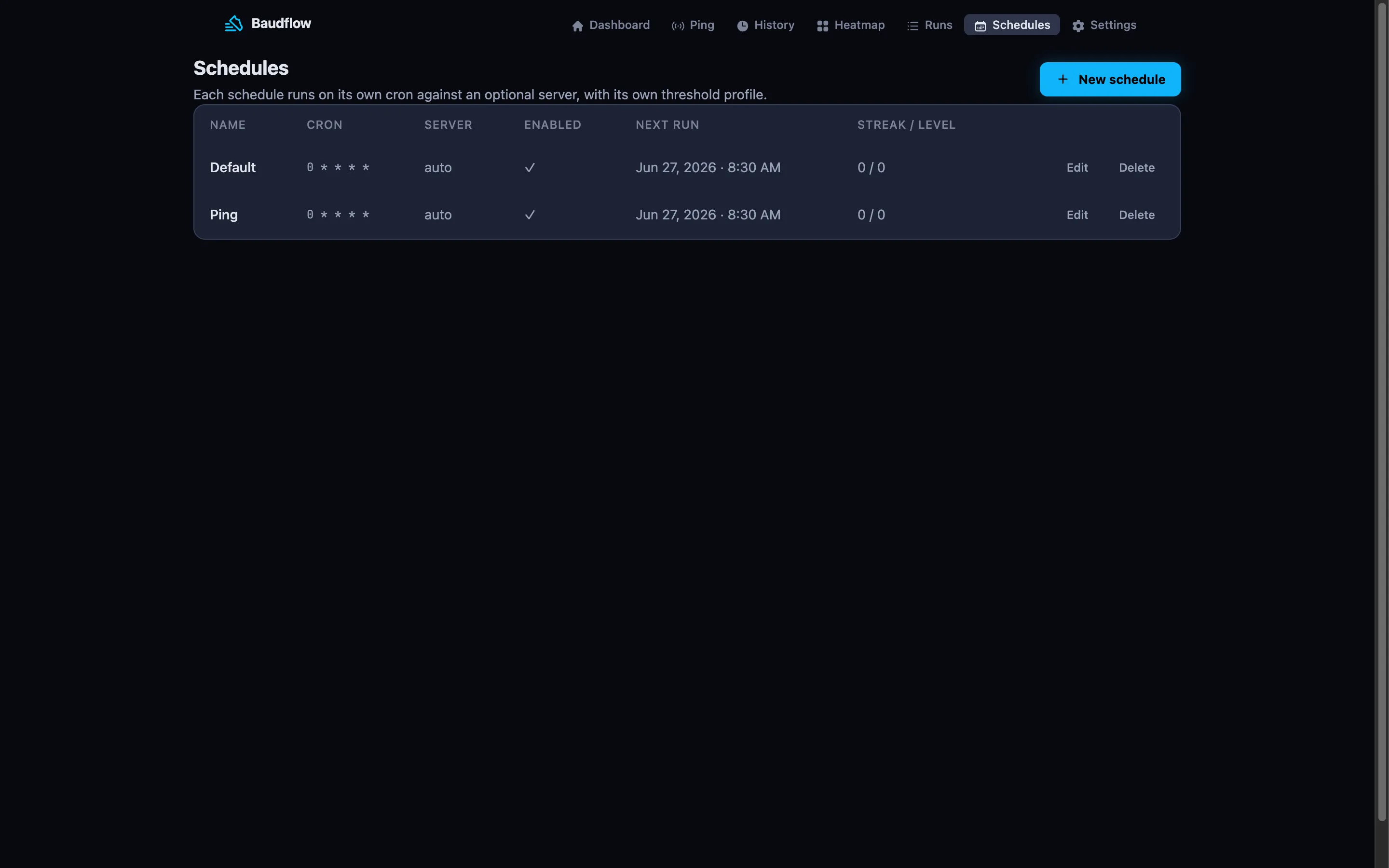
A fresh install seeds two defaults (an hourly Default speed test and an hourly
Ping schedule), both escalating to every 15 minutes on a breach. Add or edit
them on the Schedules page (/schedules).
Each schedule owns:
| Field | Meaning |
|---|---|
cron |
Base cadence, e.g. 0 * * * * (hourly). |
escalated_cron |
Faster cadence used while escalated. Blank = no speedup. |
test_type |
ookla (speed test) or ping (TCP-connect). |
server_id |
Pin an Ookla server (speed tests only). |
target_host |
Override the ping target for this schedule. |
enabled |
Disable without deleting. |
threshold_* |
Per-schedule threshold override (see Health). |
A malformed cron is rejected at write time and, as a defensive belt, logged and skipped at run time, so one bad row can’t stall the per-minute queue.
Adaptive cadence
This is baudflow’s signature behavior: when a schedule breaches, it runs faster until it recovers, capturing a granular outage timeline without spending bandwidth the rest of the time.
Set an escalated_cron (the default is */15 * * * *). When HealthWorker
detects a breach it bumps the schedule’s escalation_level; the single reader
Scheduling.active_cron/1 then returns the escalated cadence instead of the base
one. On recovery the level steps back down.
breach   → escalation_level++ → active_cron() returns escalated_cron
recover  → escalation_level-- → active_cron() returns cron (floored at 0)
The level is mutated with compare-and-set update_all (never get→change→update),
so concurrent jobs on the same row can’t race. Without an escalated_cron, the
level is inert and the schedule always runs its base cadence.
What stays decoupled
Cadence, escalation, and health are each owned by exactly one module: the schedule
row owns escalation state, Scheduling is the only thing that mutates it, and
Health is the only thing that computes a transition. Adaptive testing is a
switch in one reader, not a parallel code path.