
Configuration
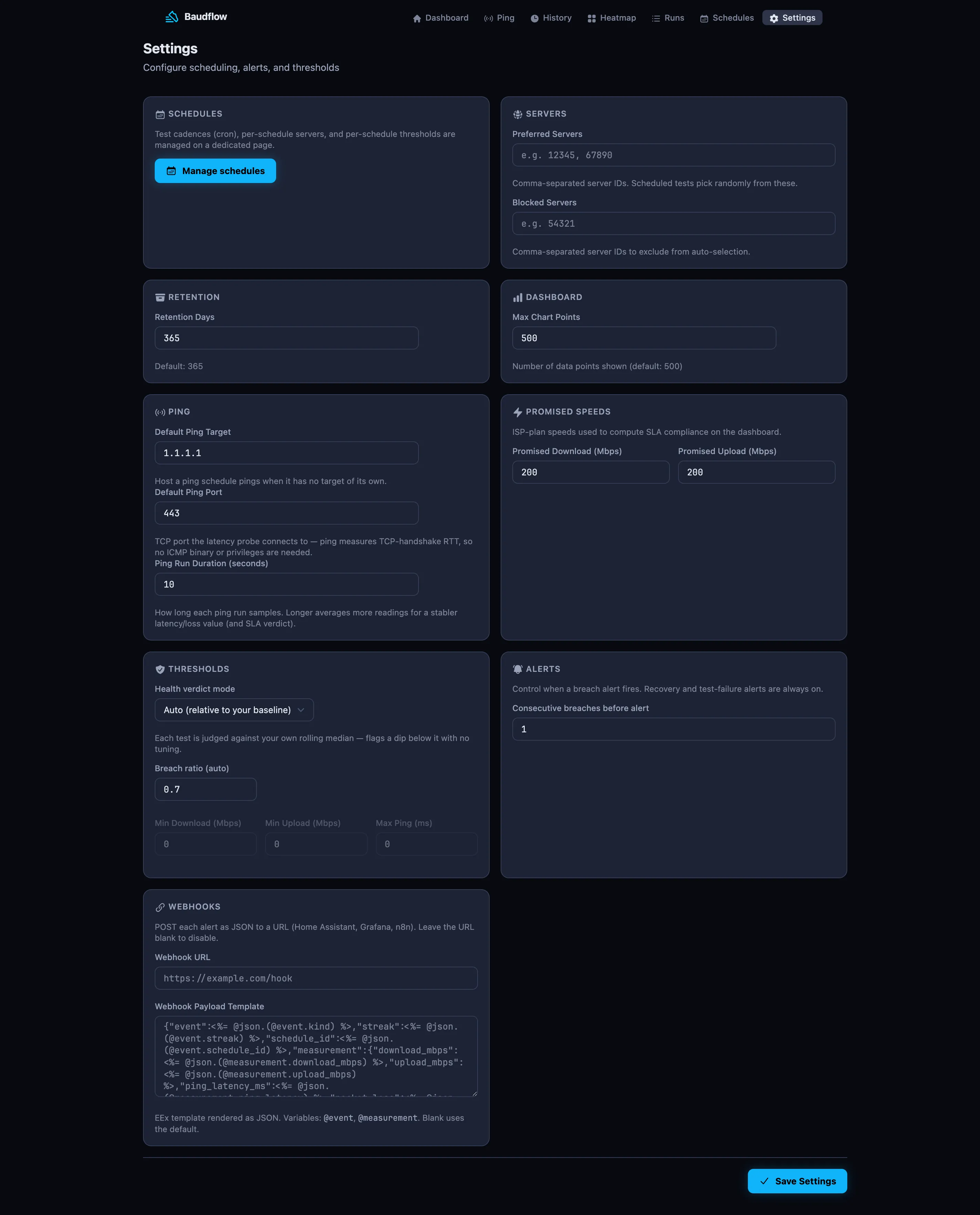
Almost everything is configured at runtime from the Settings page
(/settings) and the Schedules page (/schedules). There are no config
files to edit for normal operation.
Settings
Settings is a typed key-value store. It holds strings and returns typed values
with a safe fallback (a bad value never crashes a queue), and every key ships
with a default. Read the full list in the
Configuration reference.
Schedules
Scheduling is data, not config keys. Each schedule is a row that owns its
cron, its test type (Ookla speed test or TCP-connect ping), its server, its ping
target, and its own escalation state. The scheduler is a thin per-minute
dispatcher: it asks Scheduling.due_now() and enqueues whatever’s due.
Run several at once (hourly against your ISP, every 15 minutes against Cloudflare, a frequent ping) without touching a config file. See Schedules & adaptive cadence.
Thresholds
What counts as “healthy” resolves as per-schedule override → global Settings
fallback, through a single reader (Scheduling.thresholds_for/1) so resolution
never yields nil. Three modes:
auto(default): judges each test against the connection’s own rolling baseline; zero-config.absolute: against fixed Mbps / ms values.off: no verdict.
Per-schedule thresholds are a tristate (Inherit / Enabled / Disabled). See Health & thresholds.
Servers
- Preferred servers: pin tests to specific Ookla server IDs.
- Blocked servers: exclude server IDs from selection.
Both are comma-separated lists, resolved through one reader.
Notifications
Alerts are behaviour implementations, not branches in a worker. The worker
orchestrates a four-layer pipeline (event → policy → template → channel), and a
new channel is one module. ntfy and webhook ship out of the box. See
Notifications.
Ping target
A schedule may override the ping target and port per row; otherwise it falls back to the global setting:
schedule.target_host || Settings.get("ping_target")
schedule.target_port || Settings.get_integer("ping_port", 443)
The ping runner measures TCP-handshake RTT, so it works unprivileged with no binary. See Ping monitoring.